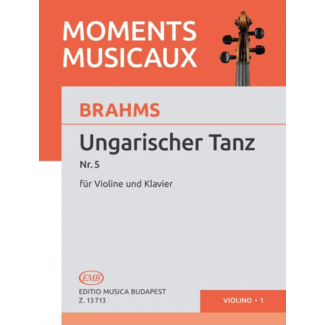
In 1869 the first edition of the “Hungarian Dances for piano for four hands by Johannes Brahms” was published. A two-part series was published in ...More
In 1869 the first edition of the “Hungarian Dances for piano for fou...
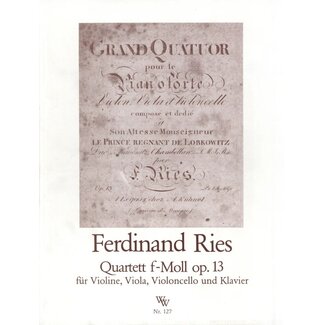
Discover the dramatic and expressive Piano Quartet No. 1 in F minor, Op. 13 by Ferdinand Ries, a hidden gem of the early Romantic era. Composed in 180...More
Discover the dramatic and expressive Piano Quartet No. 1 in F minor, O...
When Dvořák wrote his Serenade for 10 winds and 2 lower strings in January 1878, the heyday of the great wind serenades and “Harmoniemusik” wind...More
When Dvořák wrote his Serenade for 10 winds and 2 lower strings in J...
Maurice Ravel's melancholy popular 'Pavane for a Dead Princess' composed in 1899 was originally written for piano before he arranged it for orchestra ...More
Maurice Ravel's melancholy popular 'Pavane for a Dead Princess' compos...
Ferdinand Ries (baptised 28 November 1784 – 13 January 1838) was a German composer. Ries was a friend, pupil and secretary of Ludwig van Beethoven. ...More
Ferdinand Ries (baptised 28 November 1784 – 13 January 1838) was a G...
Bruckner's superior Joseph Hellmesberger Sr. requested Bruckner for a string quartet. Instead of a string quartet, Bruckner composed a viola quintet, ...More
Bruckner's superior Joseph Hellmesberger Sr. requested Bruckner for a ...
The poem "Gruselett" is taken from Christian Morgenstern's "Gallows Songs" (1905). The English translation used here was prepared by the composer hims...More
The poem "Gruselett" is taken from Christian Morgenstern's "Gallows So...
Alexander Zemlinsky’s music was long unjustly overshadowed by what was regarded as the more progressive” Second Viennese School. Although Zemlinsk...More
Alexander Zemlinsky’s music was long unjustly overshadowed by what w...
When the greatest German composer was discussed around 1720, Johann Sebastian Bach's name was never mentioned; instead, his friend Georg Philipp Telem...More
When the greatest German composer was discussed around 1720, Johann Se...
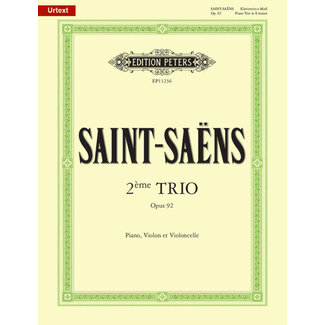
The Piano Trio No. 2 in E minor, Op. 92, was composed by Camille Saint-Saëns in 1892. It was premiered on 7 December 1892 at the Salle Érard in Pari...More
The Piano Trio No. 2 in E minor, Op. 92, was composed by Camille Saint...
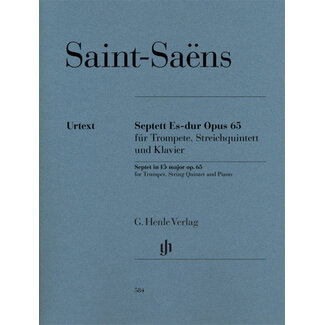
The septet was composed in 1879/80, commissioned for the Parisian Chamber Music Society “La Trompette”. Saint-Saëns had, however, hesitated for s...More
The septet was composed in 1879/80, commissioned for the Parisian Cham...
Gabriel Fauré's Piano Quartet No. 2, in G minor, Op. 45, is one of the two chamber works he wrote for the conventional piano quartet combination of p...More
Gabriel Fauré's Piano Quartet No. 2, in G minor, Op. 45, is one of th...
John Field (26 July 1782, Dublin – 23 January 1837, Moscow) was an Irish pianist, composer and teacher widely credited as the creator of the nocturn...More
John Field (26 July 1782, Dublin – 23 January 1837, Moscow) was an I...
Béla Bartók composed his Piano Quintet while at grammar school in Pozsony (Pressburg, now Bratislava), and it still shows the influence of Brahms in...More
Béla Bartók composed his Piano Quintet while at grammar school in Po...
Klengel’s Children’s Trio Op. 35/2, an "only child" in our catalogue just in 1993, has cheerfully welcomed three new siblings into the family. Two...More
Klengel’s Children’s Trio Op. 35/2, an "only child" in our catalog...
Two instruments – sometimes two violins, sometimes violin and double-bass or clarinet and bassoon – always take the lead as a duo in the ensemble ...More
Two instruments – sometimes two violins, sometimes violin and double...