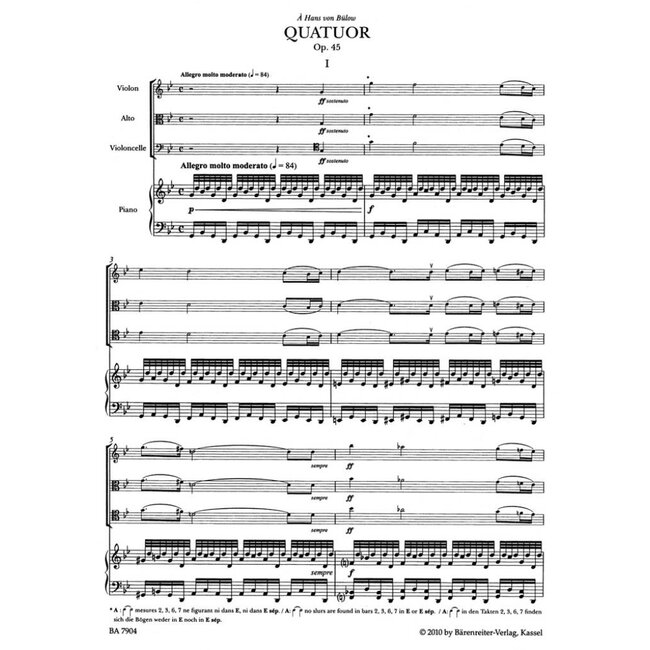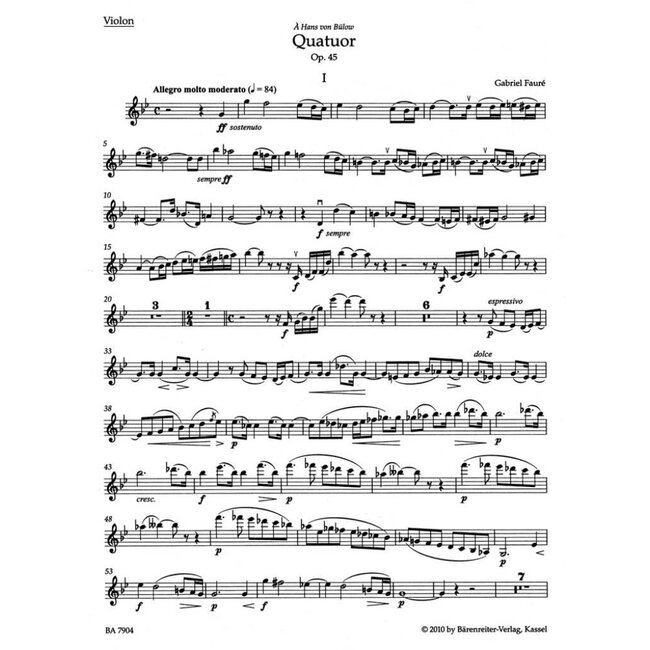


Gabriel Fauré's Piano Quartet No. 2, in G minor, Op. 45, is one of the two chamber works he wrote for the conventional piano quartet combination of piano, violin, viola and cello. It was first performed in 1887, seven years after his first quartet.
Fauré's previous work in the genre, the Piano Quartet No. 1, Op. 15, had been favourably received at its premiere in 1880, and was among the chamber works for which he had been awarded the Prix Chartier by the Académie des Beaux-Arts in 1885. Little is known about the composer's reasons for writing another. It was not commissioned, and appears to have been written because Fauré was interested in the possibilities of the piano quartet medium, and was wary of writing chamber music with no piano part. The Fauré scholar Jean-Michel Nectoux comments that the choice of this unusual form showed the composer's desire to break new ground and be his own man. Nectoux adds that there was the advantage that the existing classical repertory contained very few top-flight piano quartets with the exception of Mozart's.
It is not certain when Fauré began work on the Second Quartet, but writers generally agree that it was in either 1885 or 1886, and the work was completed in time to be premiered on 22 January 1887. It was given at the Société Nationale de Musique by Guillaume Remy (violin), Louis van Waefelghem (viola), Jules Delsart (cello) and the composer (piano).
Fauré adopts the classical four-movement structure: an opening Allegro is followed by a scherzo, slow movement, and finale. This follows the pattern of German Romantic works such as Schumann's Piano Quartet, Op. 47 and Brahms's Piano Quartet, Op. 25.
Movements: