

In the oeuvre of Ludwig van Beethoven, the string quartet (along with the symphony and the piano sonata) is the genre to which he contributed in a manner characteristic of the various phases of his development.
From early in his career, Beethoven was successful in securing support from wealthy, music-loving noblemen. For instance, from the moment he left Bonn for Vienna, he received support from Count Waldstein. A significant portion of the string quartets were commissioned. This applies to the six quartets of Opus 18 (dedicated to Prince Lobkovitz), the three quartets of Opus 59 (dedicated to Count Rasumovsky), and three of the last five quartets (dedicated to Prince Nikolai Golitsyn). Rasumovsky maintained a quartet from 1809 to 1816, of which Schuppanzigh was the first violinist. This quartet specialized in performing Beethoven's quartets.
Early Period Quartets:
Between 1798 and 1800, Beethoven wrote a cycle of 6 string quartets, all with opus 18:
String Quartet No. 1 in F
String Quartet No. 2 in G
String Quartet No. 3 in D
String Quartet No. 4 in C
String Quartet No. 5 in A
String Quartet No. 6 in B-flat
Middle Period:
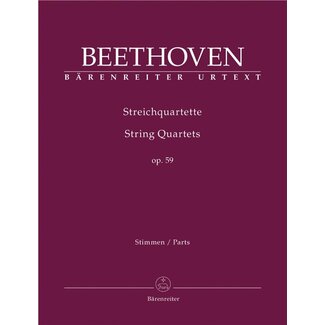
This concerns five quartets: the three Rasumovsky Quartets opus 59 and the quartets opus 74 and 95 (written between 1806 and 1810). String Quartet No. 7 in F Major (opus 59.1)
String Quartet No. 8 in E Minor (opus 59.2)
String Quartet No. 9 in C Major (opus 59.3)
String Quartet No. 10 in E-flat Major (opus 74) - sometimes called "Harp Quartet" (after the German Harfenquartett)
String Quartet No. 11 in F Minor (opus 95) - Quartett Serioso
Late Period (1822-1826):
This concerns the last 5 quartets, which were written between 1822 and 1826.
String Quartet No. 12 in E-flat Major (opus 127)
String Quartet No. 13 in B-flat (opus 130)
Große Fuge (opus 133) - originally the last movement of the 13th string quartet
String Quartet No. 14 in C-sharp minor (opus 131)
String Quartet No. 15 in A minor (opus 132)
String Quartet No. 16 in F major (opus 135)