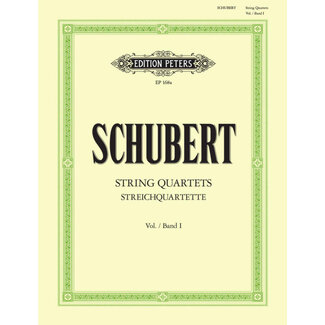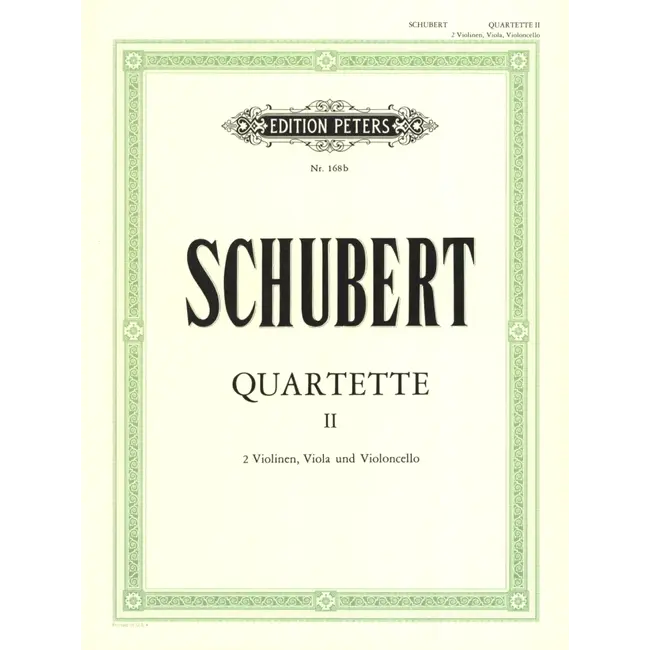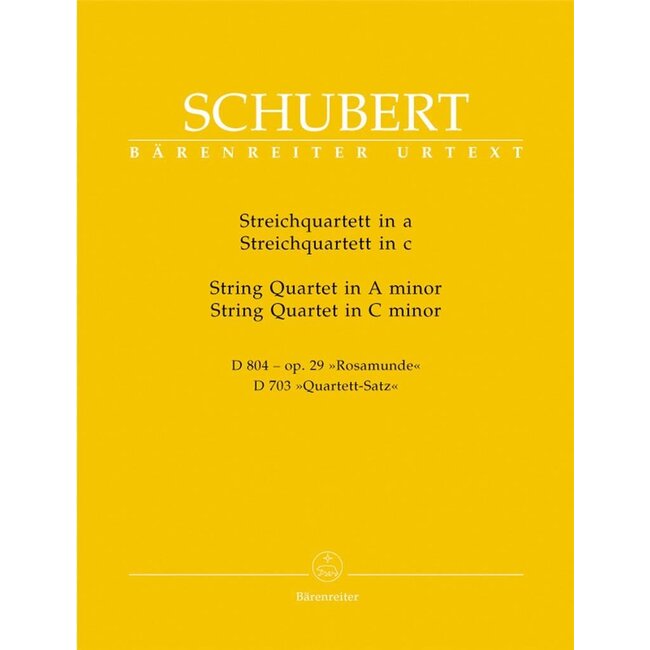


The Austrian Franz Schubert (1797 – 1828) did not really stand in the spotlight during his lifetime. He was not a crowd favorite like his predecessors Mozart and Beethoven, for example. Nevertheless, Schubert must be considered one of the most important composers in music history. First and foremost, he is known as a song composer.
Schubert was an all-round composer. In addition to 600 songs, he wrote masses, symphonies, and a large amount of chamber music, including a considerable number of string quartets. Highly beloved quartets are the Rosamunde Quartet and *Der Tod und das Mädchen* (Death and the Maiden). (See the archive for these two quartets). Just like the final string quartets of his idol Beethoven, Schubert's final quartets can be labeled masterpieces.
Schubert was already writing string quartets from the age of 11. Several string quartets or parts thereof have been lost. It is assumed that he wrote about 20 of them.
Available:
Edition Peters Verlag
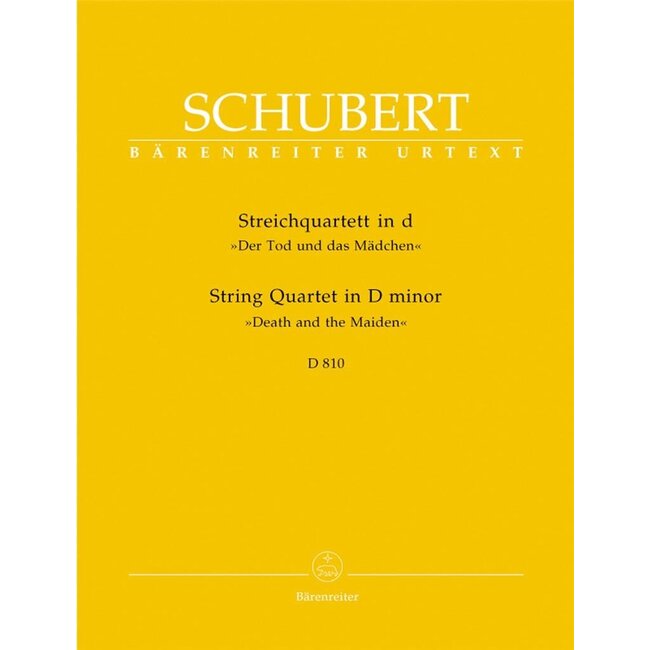
Bärenreiter Verlag
The New Schubert Edition is a scholarly-critical complete edition reflecting current knowledge of the sources and the latest research findings. It is thus indispensable for the study and authentic performance ofSchubert's music.
Franz Schubert composed the song “Death and the Maiden” in 1817, and in 1824 used that melody in the theme-and-variations second movement of his String Quartet in d minor D. 810. The song’s popularity in the second half of the 19th century was responsible for the string quartet becoming known by the title “Death and the Maiden”. Like all of Schubert’s mature chamber music works, it captivates with its technical perfection and high intellectual demands. Very prominent here is Schubert’s desire to motivically link the movements together. Oddly enough, the work was neither performed nor published during his lifetime, the incomplete autograph score and the posthumous first editionof 1831 have thus served as the sources for our edition.
Henle Verlag
Franz Schubert composed the song “Death and the Maiden” in 1817, and in 1824 used that melody in the theme-and-variations second movement of his String Quartet in d minor D. 810. The song’s popularity in the second half of the 19th century was responsible for the string quartet becoming known by the title “Death and the Maiden”. Like all of Schubert’s mature chamber music works, it captivates with its technical perfection and high intellectual demands. Very prominent here is Schubert’s desire to motivically link the movements together. Oddly enough, the work was neither performed nor published during his lifetime, the incomplete autograph score and the posthumous first editionof 1831 have thus served as the sources for our edition.
Schubert only took ten days to write his String Quartet in G major, one of his truly monumental chamber music works. With its almost symphonic dimensions, this late quartet is reminiscent of his great String Quintet in C major. As divulged in a letter, Schubert actually wanted to “pave the way for the large symphony” with this quartet and several other chamber music works that he composed around the same time. Written in 1826, the quartet was not performed in public during the composer’s lifetime- and it was only published long after his death. Our Urtext edition with its accompanying study edition is therefore based on the surviving autograph.?
Other string quartets by Schubert are available upon request.