
Vincent d’Indy (1851-1931) was born of aristocratic stock. His musical talent was recognized by his grandmother who raised him and saw that he received piano lessons from famous teachers. Despite this, he was sent to law school in Paris. Instead, D’Indy, who was intent on becoming a composer, joined a Parisian orchestra as a timpanist to learn music “from the ground up.” Both Massenet and Bizet were impressed by his early compositions and encouraged him to show his work to César Franck. Franck did not share their enthusiasm and was reputed to have told D’Indy, “You have ideas but you cannot do anything.” Apparently those ideas were enough, however, to convince Franck to show D’Indy how to do things, as he took the latter on as a pupil. Though D’Indy was to assimilate and be influenced by many different sources, Franck and his music left the most telling mark on him. D’Indy’s reputation, during his own lifetime was considerable, having founded, in 1900, what was to become the most important music school in France after the Paris Conservatory—The Schola Cantorum.
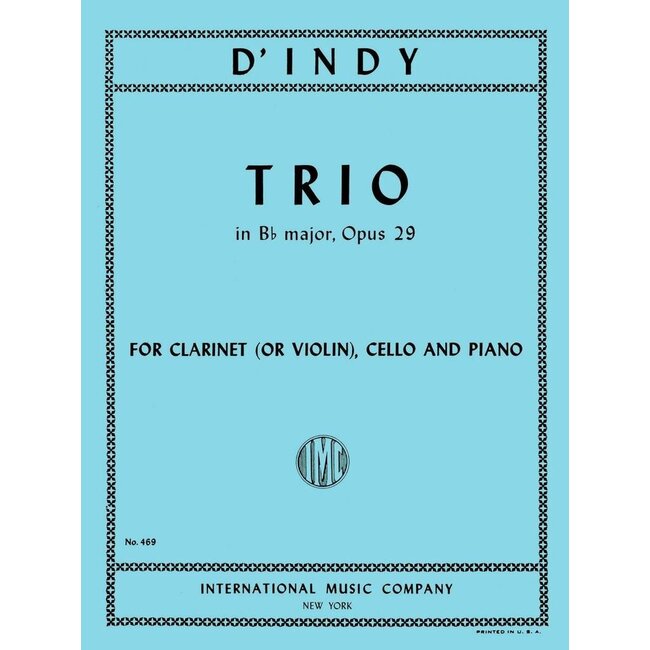
Although d'Indy composed this trio with the clarinet in mind, at the request of his publisher, he also produced an alternate violin part and took especial care so that it sound both natural and effective as a standard piano trio. It is a beautiful work in both versions.
Instrumentation: Clarinet (or violin), Cello and Piano.