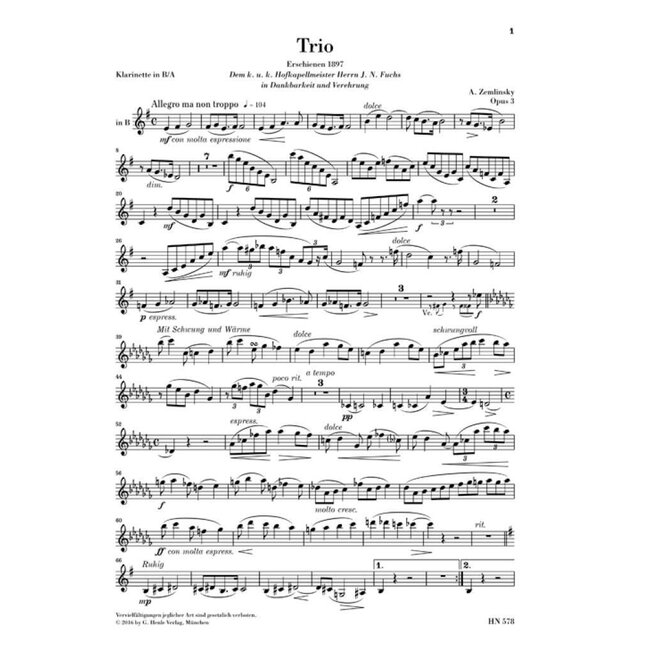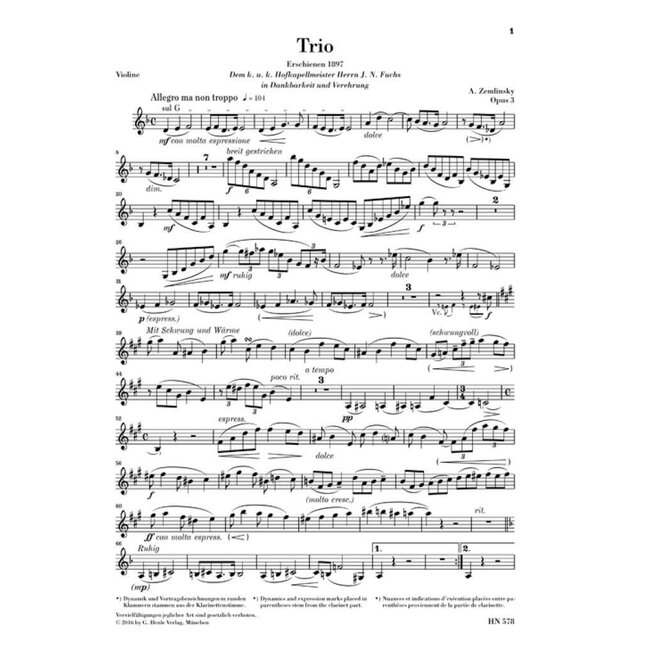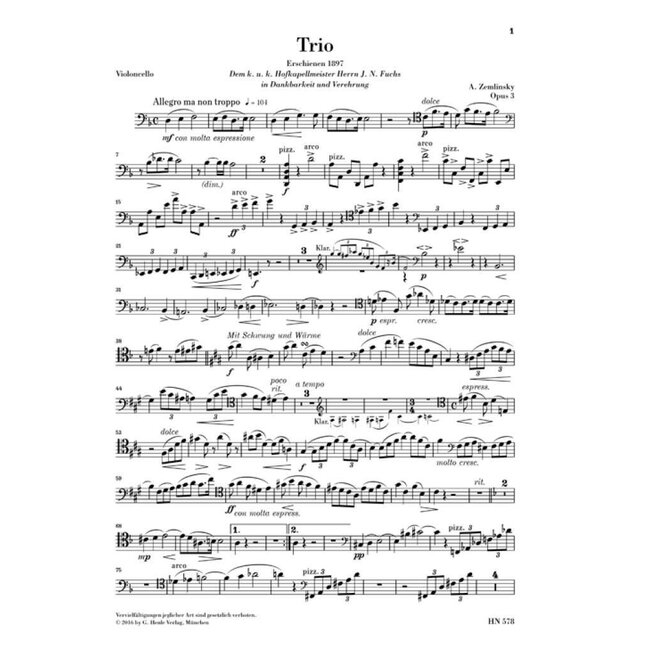
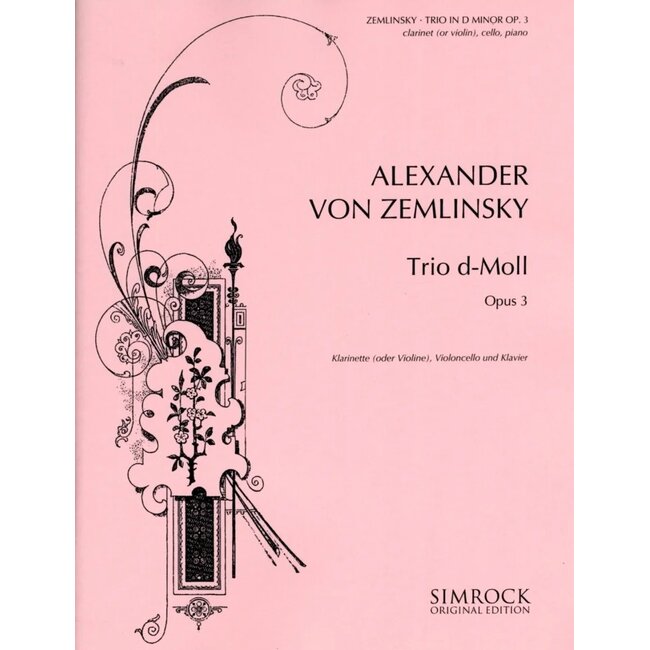


Alexander von Zemlinsky, along with Mahler and Strauss, was one of the intellectual fathers of the Viennese School. His influence is exemplified by Schoenberg's life. Zemlinsky initially gave the young Schoenberg, only three years his junior, composition lessons, became his collaborator in the movement for New Music in Vienna, and in 1901, his brother-in-law.
Zemlinsky's Trio in D minor, Op. 3, introduces yet another model: Brahms. The trio was composed a year before Brahms's death in 1896, and, as is so often the case with composers of the younger generation, the Viennese master exerted his influence on the trio. This is hardly surprising, as it is a testament to his all-encompassing influence on chamber music. The trio is, in general, thoroughly "Brahminian" in terms of harmony, melodic structure, and sound. In particular, it was Brahms's Clarinet Trio, Op. 114, that served as Zemlinsky's model. The instrumentation and many formal and motivic details originate from there.
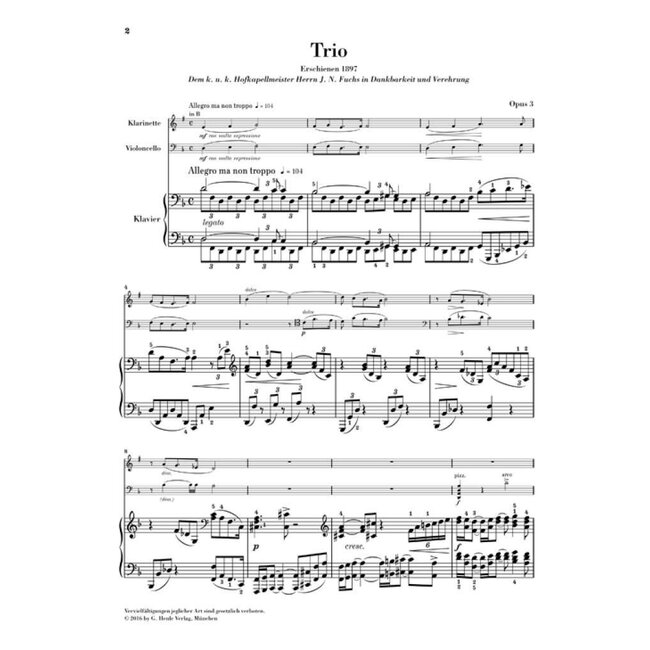
Thus, the first movement in Zemlinsky's work, like Brahms's, begins with the main theme, played piano by the clarinet and cello. The piano responds with a sharply rhythmic contrasting motif, whereupon the main theme resounds in a powerful forte. In the development section, both themes are dramatically contrasted. The tremendous crescendos that arise are typical of the young Zemlinsky. After such a climax, the lyrical secondary theme reappears in the development. A second, even more powerful climax leads the main theme to a symphonic apotheosis at the end. The influence of Brahms is less noticeable in the slow movement. With its meandering harmonies and chromatic melodies, it is more reminiscent of Schoenberg's teacher. Between the outer sections in D major is a rhapsodic middle section in D minor, "Poco mosso con fantasia." In keeping with the "spirit of the times" of the late 19th century, the finale returns to the beginning: its rondo theme is a capricious embellishment of the main theme from the first movement. The relationship becomes clear towards the end, when the latter gradually emerges from its variation and finally reappears in its original form.
Feedback sturen