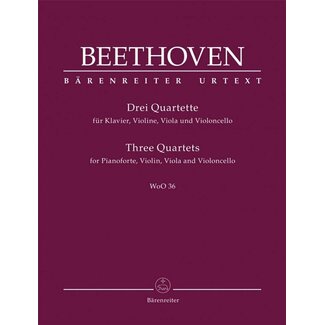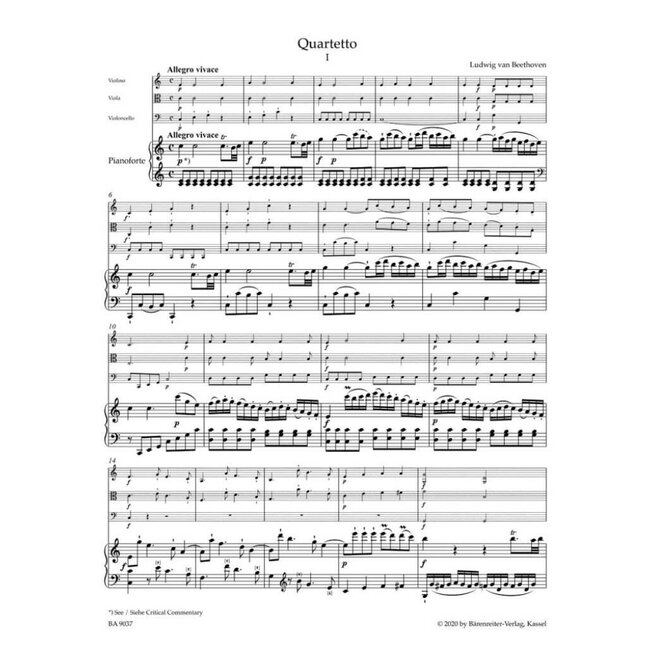
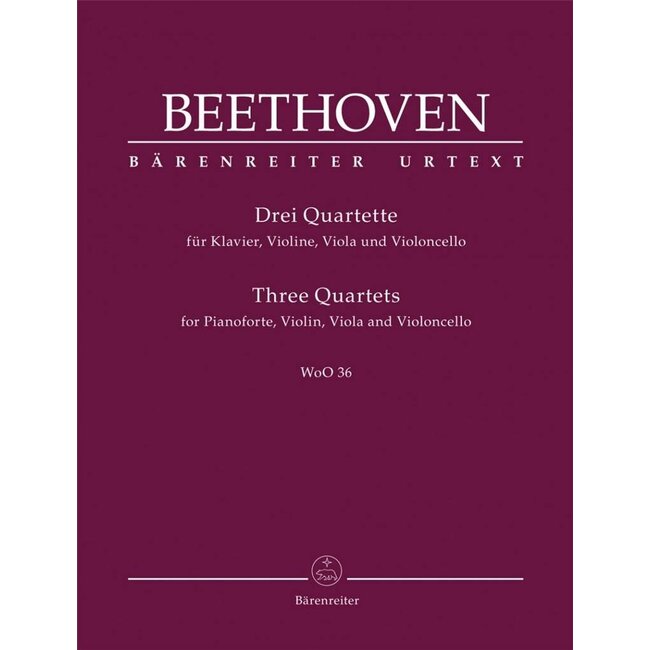


The Piano Quartets, WoO 36, by Ludwig van Beethoven are a set of three piano quartets, completed in 1785 when the composer was aged 14. They are scored for piano, violin, viola and cello. He composed a quartet in C major, another in E♭ major, and a third in D major. They were first published posthumously in 1828, however numbered in a different order: Piano Quartet No. 1 in E♭ major, Piano Quartet No. 2 in D major, and Piano Quartet No. 3 in C major.
When Beethoven composed these three pieces, the Piano Quartet was a rarely used ensemble.Two works by Mozart, Piano Quartet No. 1 in G minor (1785) and Piano Quartet No. 2 in E♭ major (1786), are the only significant contemporary contributions that are comparable. Beethoven modeled his piano quartets after a set of Mozart violin sonatas published in 1781, with Beethoven's C major work written in the same key and borrowing some thematic material from Mozart's Violin Sonata No. 17, K. 296. Apart from Beethoven's own arrangement of his Quintet for Piano and Wind Instruments (Op. 16) for piano quartet, these three works are the only compositions he wrote for piano, violin, viola, and cello.
Beethoven later reused material from the C major quartet for two of his early Piano Sonatas: No. 1 and No. 3. In Beethoven's original manuscript, the work in C major comes first, followed by E♭ major and D major. When the quartets were published after his death by Artaria in Vienna, there were in a different order: E♭ major, D major, and C major.