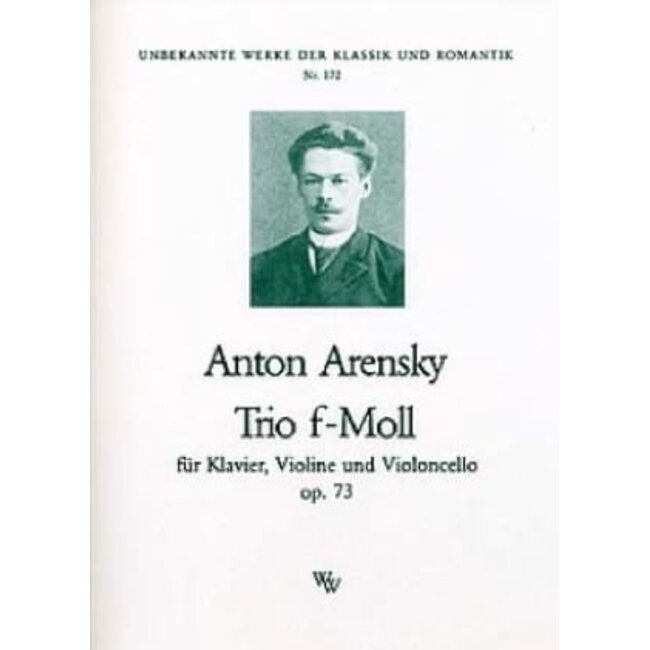
Arensky, born on July 12, 1801, in Novgorod, studied under Johannsen and Rimsky-Korsakov at the St. Petersburg Conservatory. As early as 1883, he became a composition teacher at the Moscow Conservatory. In 1895, he returned to St. Petersburg and became director of the court choir there. On February 25, 1906, Arensky died of tuberculosis in Terioki, Finland. Arensky occupies a very special place in the musical history of his country. Having emerged from the school of Rimsky-Korsakov, he gradually distanced himself from the ideals of the national Russian school, championed above all by the group of five composers—Balakirev, Borodin, Mussorgsky, Cui, and Rimsky-Korsakov, the so-called "Mighty Handful"—and aligned himself with the contrasting Western currents, represented primarily by Rubinstein and Tchaikovsky. Arensky was particularly impressed by Tchaikovsky's personality, so much so that its influence on Arensky's entire style is clearly perceptible. Indeed, with certain reservations, one finds many common traits between Arensky and Tchaikovsky, especially in their lyrical sensibility, their refined formal structure, the songlike quality of their melodies, and, not least, their masterful compositional skills. Arensky remained ideologically committed to the great tradition of German Romanticism; and although elements of Russian folk music frequently found their way into his compositions, they are—considered insignificant in the context of his overall work. Without a doubt, Arensky's chamber music, even though a certain Tchaikovsky influence is noticeable, ranks among the most important compositions of his oeuvre. Free from the often impersonal uniformity that characterizes the music of some of the lesser-known composers of the so-called New Russian School, they are marked by a distinctive style. Arensky enriched the literature for piano trio with two works, the second of which is now being reprinted after a long hiatus – the first edition appeared in 1905 – finally making it available again. Energetic, spirited, and with generously drawn lines, the first movement immediately captivates both player and listener. The composer's Russian origins are evident in the lyrical second movement, structured as a romance, in which the strings, in particular, are given rewarding roles. This is followed by a scherzo with sophisticated harmonies that oscillate between major and minor keys. The final movement consists of varied, sometimes Russian-influenced variations on a simple, folk-like theme. Similar to Tchaikovsky's trio, these are small character pieces of a highly appealing style.