

Mozart composed more than 20 string quartets, including famous series such as the Milanese Quartets (KV 155-160) and the six "Haydn Quartets". His String Quartet No. 19 in C major, known as the "Dissonance Quartet" (KV 465), is one of his most notable works. Important String Quartets by Mozart: Early Quartets: Written in the 1770s, including the Milanese Quartets (KV 155-160) from 1772-1773. Viennese Quartets (KV 168-173): Composed in Vienna in 1773. Haydn Quartets (1782-1785): A series of six quartets dedicated to Joseph Haydn, including the Dissonance Quartet.
Subdivision and groupings:
Available:
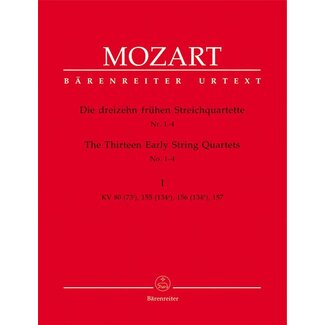
In his youth, Mozart produced two authentic cycles of six string quartets: K.155 160 (Nos.2 7) and K.168 173 (Nos.8 13). Together with their forerunner, the so-called “Lodi” Quartet, K.80 (No.1), this adds up to atotal of thirteen juvenile quartets, all of which may be regarded as early prototypes of their genre.
Early period (Baerenreiter Verlag)
Italian Quartets (Henle Verlag)
This volume brings together Mozart’s youthful attempts at this later so central genre of the string quartet: the astonishing “Lodi Quartet” K. 80 by the only fourteen-year-old composer, the three “Quartet-Divertimenti” K. 136–138 which are also readily played by chamber orchestras, and Mozart’s first true string-quartet cycle K. 155–160 which was composed during his third (north-)Italian journey in 1772/73. Mozart’s cleanly written scores of all the compositions have been preserved so that the edition stands on a secure foundation. In his informative commentary, Wolf-Dieter Seiffert, the experienced Mozart editor at G. Henle Publishers, devotes a separate, comprehensive explanatory section to the well-known articulation problem “dot or wedge”. The Armida Quartet provided artistic input for this edition.
Early Vienna Quartets (Henle Verlag)
After Volumes IV and III of the series with Mozart’s complete string quartets appeared as Henle Urtext editions in early 2017 and 2019 respectively, Mozart expert Wolf-Dieter Seiffert now presents Volume II in full score and individual parts. Included are the “Early Viennese Quartets” from 1773, K. 168 173. Entries in the autograph manuscript by the composer’s father Leopold, however, suggest that the ordering of the six works into a unified series of quartets was his doing. In his preface, Wolf-Dieter Seiffert shares brand-new findings on the actual chronology of the genesis of these quartets. Moreover, he succeeds in correcting what in prior editions were occasionalinaccuracies in dynamics and articulation, thereby producing a new, assured musical text. With artistic input from the Armida Quartet, Volume II of the String Quartets also sets the benchmark in the Mozart Edition!
Quartet in G minor for Piano, Violin, Viola and Violoncello
Mozart's Piano Quartet No. 1 in G minor, K. 478, is scored for violin, viola, cello, and pianoforte. It was composed in 1785.
Eine kleine Nachtmusik for string quartet
The Serenade No. 13 in G major for stringquartet, KV 525, popularly known as Eine kleine Nachtmusik[a], is a 1787 composition for a chamber ensemble by Wolfgang Amadeus Mozart (1756–1791). The German title means "a little night music"[b] and it is one of the most famous pieces of classical music. The circumstances around the composition of this piece are not known. The extant piece contains four movements: Allegro, Romance, Menuetto, and Finale. However, another movement is now believed to be lost.
Other Mozart string quartets are vailable on request.