
Menu
EUR
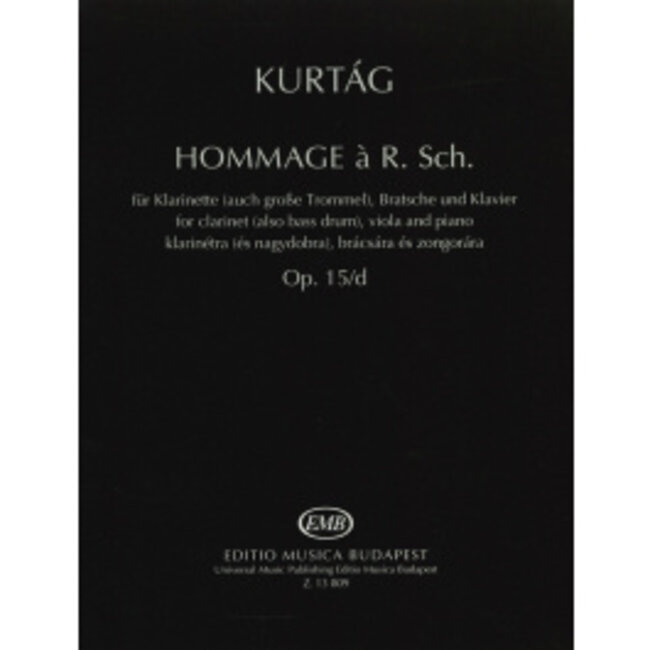
Hommage a R. Schg.
€32,75 Incl. tax
Add to cart
Hommage a R. Schg.
Kurtag
Hommage a R. Schg.

Hommage a R. Schg.

€32,75 Incl. tax
In stock
Dispatch within 1-2 workdays

Kurtág was born into a Hungarian-Jewish family in northern Romania and moved to Budapest in 1946 at the age of twenty. He spent the year following the 1956 uprising in Paris, ostensibly to study with Messiaen and Milhaud, but in reality, Read more.

  • The store & webshop for bowed instruments
  • Large assortment
  • Sale and rental of string instruments
  • Vioolbouw, restauratie & onderhoud

Product description

Kurtág was born into a Hungarian-Jewish family in northern Romania and moved to Budapest in 1946 at the age of twenty. He spent the year following the 1956 uprising in Paris, ostensibly to study with Messiaen and Milhaud, but in reality, he underwent psychoanalysis with Marianne Stein and "purified" himself by subsisting solely on rice and performing angular gymnastic exercises. He copied Webern's scores and crafted stick figures from matchsticks, dust bunnies, and cigarette butts, read Kafka's "The Metamorphosis," and felt like a "cockroach striving to transform into a human being, searching for light and purity." He returned to Budapest, discarded his earlier compositions, and created his "Opus 1," a string quartet which he dedicated to Stein.

Although Kurtág's style is distinctive, many of his compositions eclectically allude to others: Hommage à Nancy Sinatra, Hommage an Tchaikovsky, In Erinnerung an einen Gerechten, Omaggio a Luigi Nono, and today's piece, Hommage à Robert Schumann, which is based on fairy tales and uses the same instrumentation. Kurtág wrote the first movement in 1975 and completed the work in 1990. The movements of this short (10-minute) work refer to Schumann's alter egos Florestan, Eusebius, and Meister Raro, and, in the first movement, to Johannes Kreisler, a fictional, capricious, and unsociable composer who was the alter ego of the writer E. T. A. Hoffmann and who, in turn, inspired Schumann's Kreisleriana. The first five movements are, as with Webern, very short. The longer final movement refers to Guillaume de Machaut, a 14th-century poet and composer who was particularly influential in the development of isorhythmic motets (in which a repeating rhythm contributes to the unification of the piece). Here, the three players independently repeat their own rhythmic pattern, the piano strictly, the other two voices gradually intensifying their rhythms.
Specifications

Article number
Z.13 809
Vragen over dit product
If you have any questions about this product, please call us on +31 (0)70 221 0831 or send us an email at [email protected].

Related products

Vragen over dit product
If you have any questions about this product, please call us on +31 (0)70 221 0831 or send us an email at [email protected].

Recently viewed

Kurtag Hommage a R. Schg.
Kurtag
Hommage a R. Schg.
Kurtág was born into a Hungarian-Jewish family in northern Romania and moved to ...
€32,75 €30,05
 
Lajos Duos for violin and viola for beginners
Lajos
Duos for violin and viola for beginners
The volumes of this successful series cover the entire music literature from the...
€16,80 €15,41
 
Elsholz, Anja Baroque duets with Susi and Eddi
Elsholz, Anja
Baroque duets with Susi and Eddi
Baroque Duets with Susi and Eddi is a collection of sonorous violin duets in the...
€10,90 €10,00
 
Haydn Six Sonatas for Violin and Viola
Haydn
Six Sonatas for Violin and Viola
The title “Solo per il Violino” which Haydn gave these sonatas in his “Entwurf-K...
€33,40 €30,64
 

Specifications

Article number
Z.13 809
0/5
0 stars based on 0 reviews
0 reviews
Choose your language
Choose your currency

Recently added

Total incl. tax
€0,00
0
Compare
Start comparison

Review Kurtag Hommage a R. Schg.

This product has been added to your cart