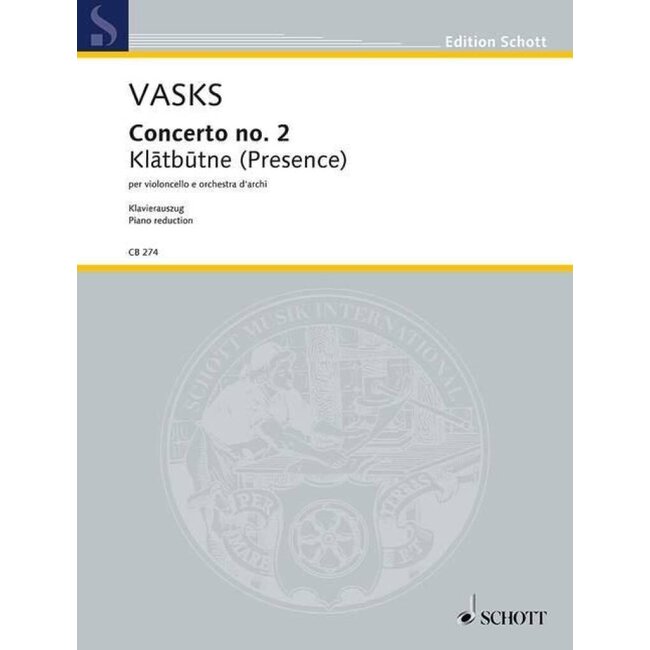
Pēteris Vasks composed this cello concerto during 1993-1994; he is one of the most popular Latvian composers. Vasks himself is a double bass player and has performed in various professional symphony orchestras in that capacity. Nevertheless, regarding this composition, he declared that his favorite instrument is the cello. The work was composed for the Lithuanian cellist David Geringas. The first performance took place in Berlin by the Deutsches Symphonie-Orchester Berlin under the direction of Arturo Tamayo.
According to the composer, the work should not be viewed solely as a standalone cello concerto. It also represents the period of humiliation and oppression during the Soviet domination of many peoples, as well as the resilience of those peoples that made it possible to survive that period (particularly, of course, that of the Baltic states). It cannot, therefore, be viewed in isolation from the fall of communism in 1989 and the regaining of independence for the three republics. The work consists of five (indicated) parts, but it is performed without interruption. It also has a symmetrical structure:
- Cantus I: Vasks presents his vision of the ideal world;
- Toccata I: this part represents the negative and disruptive forces; here Vasks quotes his own Piano Trio and alludes to Dmitri Shostakovich in the cellist's solos; here again, heavy percussion is used in combination with brass instruments;
- Monolohi: the part around which everything revolves (literally and figuratively); here, orchestral outbursts contrast with 2 cadenzas by the soloist;
- Toccata II: is a continuation of Toccata II, again featuring a cadenza for the soloist;
- Cantus II: it begins with a massive outburst before transitioning into serene music, which represents the ultimate victory of positive forces and is based on Latvian folk music.