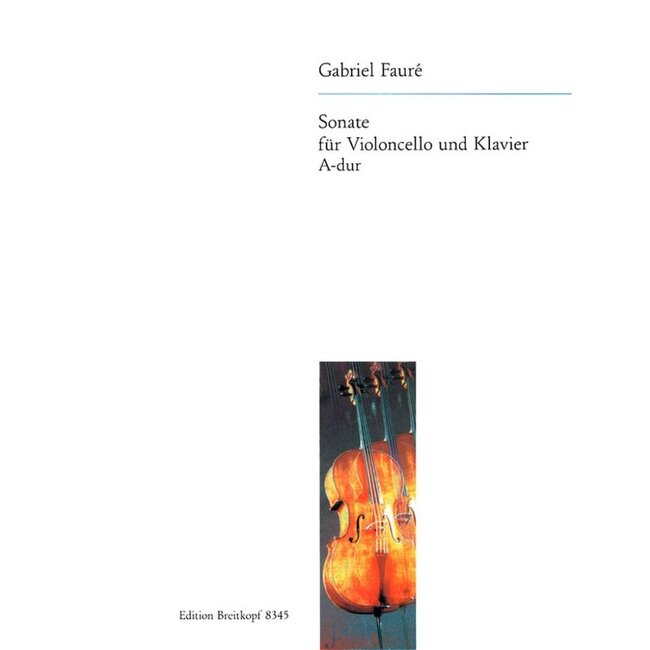
The Violin Sonata No. 1 in A major, Op. 13, was written by Gabriel Fauré from 1875 to 1876. It is considered one of the three masterpieces of his youth, along with the first piano quartet and the Ballade in F♯ major.
The sonata was conceived in the summer of 1875 during a stay in Sainte-Adresse with the family of Camille Clerc, a prominent industrialist and supporter of his work, and completed in the autumn of 1876. Clerc, who had been on excellent terms with the renowned Leipzig-based publisher Breitkopf & Härtel, made considerable efforts to get Fauré's work published. However, Breitkopf & Härtel was only willing to publish the sonata if Fauré renounced his fee: "M. Fauré is not known in Germany and the market is overflowing with works of this sort, even though they're often inferior to the one we're discussing. Fauré accepted these terms, and the work was finally published in February 1877, just weeks after the premiere on 27 January 1877.
The sonata was dedicated to his close friend Paul Viardot, the brother of Marianne Viardot, with whom Fauré was in love. The first recorded performance of the sonata took place on the eve of the premiere at the home of the Clercs, with Paul Viardot on the violin and Fauré himself playing the piano part. The private performance was met with lively enthusiasm.
The premiere itself, at a concert of the Société Nationale de Musique in the Salle Pleyel, with young violinist Marie Tayau, was a great success, with the third movement having to be encored. In a letter dated the same day, Fauré wrote: "The success of my sonata surpassed by far all my expectations!!! As to my performer, I will never be able to express adequately how she made my sonata her own, how she put her heart and spirit into playing it. Mademoiselle Tayau's interpretation was perfect.
The premiere marked a turning point in Fauré's composing career, at the age of 31. The work quickly found its way into the programmes of artists such as Benjamin Godard, Camille Saint-Saëns, Eugène Ysaÿe, Jacques Thibaud, George Enescu, Alfred Cortot and others. Writer Marcel Proust repeatedly paid tribute to the sonata in his novel In Search of Lost Time.