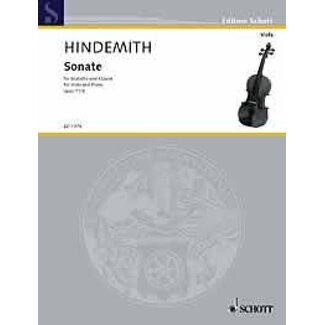
This sonata is the first of three that Hindemith wrote for viola and piano (the others are Op. 25 No. 1 and one written in 1937). Influences of earlier composers such as Brahms and Reger are evident in the piece. Debussy’s influence is also present. While Hindemith was serving in the military during World War I he formed a string quartet; this quartet was playing Debussy’s quartet when news of the composer’s death was broadcast on the radio.
Elements of Debussy’s solo string sonatas and quartet are found in the sonata, especially the opening movement. The first movement serves as a prelude to the last two movements; all three are played without interruption. The second movement is labeled as a theme and variations; the simple folk-like theme, full of melancholy (labeled “Quiet and simple, like a folk song” in the score), is stated at the outset and four variations follow. The third movement is in sonata form but is linked to the second movement in that more variations of the second movement’s theme are stated during the third movement (variations five and six of the theme serve as a substitute for a development section in the third movement and variation seven serves as the coda).